oluwatosin oyeniyi
 ADDIS ABABA — In a move that signals a profound recalibration of European diplomacy in East Africa, the European Union has officially announced the resumption of direct budget support to Ethiopia. The decision, unveiled by EU Commissioner for International Partnerships Jozef Síkela during the EU-Ethiopia Business Forum in Addis Ababa, unlocks over €140 million in funding that had been frozen since the outbreak of the Tigray conflict in late 2020. Coupled with a landmark €150 million Digital Economy Package, the announcement marks the end of a five-year diplomatic “deep freeze” and underscores Brussels’ determination to re-establish itself as a primary partner in Ethiopia’s post-war recovery and digital transformation.
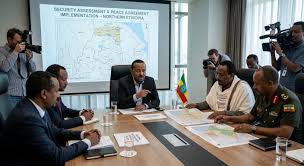
The resumption of budget support is more than a financial transaction; it is a high-stakes political endorsement of Prime Minister Abiy Ahmed’s current reform trajectory. For years, the EU maintained a principled stance, conditioning the return of direct aid on progress in human rights, accountability for wartime atrocities, and the implementation of the Pretoria Peace Agreement. By releasing these funds now, the EU is signaling that while challenges remain, the “reform milestones” achieved thus far are sufficient to warrant a return to a full-scale developmental partnership.
The €140 million budget support package is designed to flow directly into the Ethiopian treasury, targeting critical sectors that have been strained by years of conflict and economic instability. According to the European Commission, the funds will be prioritized for expanding electricity access to rural communities, strengthening healthcare systems, and improving the overall business climate to attract foreign direct investment. However, the centerpiece of this new era of cooperation is the €150 million Digital Economy Package, a flagship initiative under the EU’s “Global Gateway” strategy. This package, which the EU aims to eventually double in size, focuses on building Ethiopia’s “digital backbone.” It includes financing for fiber optic expansion, digital skills training for the country’s massive youth population—two-thirds of whom are under the age of 30 and governance reforms intended to create a more enabling environment for tech innovation.
Complementing these grants are significant lending operations from the European Investment Bank (EIB). The EIB has signed off on €130 million in new loans, including €20 million to Zemen Bank for agri-food credit and €110 million for rural finance. These measures are clearly intended to stimulate the private sector, particularly in rural areas where the economic impact of the Tigray war was most acutely felt.
The EU’s shift from strict conditionality to proactive engagement reflects a broader geopolitical reality. In the years that European aid was suspended, other global actors—most notably China and several Gulf states continued to deepen their economic and political ties with Addis Ababa. By returning to the table with a massive digital and infrastructure-focused package, the EU is attempting to offer a “European alternative” that emphasizes transparency, sustainability, and long-term institutional building.
Commissioner Síkela’s rhetoric during the forum was pointedly optimistic, describing the resumption of support as a “testament to our confidence in Ethiopia’s reform agenda.” Yet, for many observers, the move is also a pragmatic response to the instability of the Horn of Africa. Ethiopia is the region’s demographic and economic heavyweight; its stability is seen as essential for managing migration flows, countering regional extremism, and ensuring the security of vital Red Sea trade routes.
The resumption of EU support presents a dual narrative of opportunity and risk. On one hand, the infusion of capital and technical expertise is desperately needed. Ethiopia’s Damage and Needs Assessment, conducted with World Bank support, estimated the total cost of wartime destruction at over $22.6 billion. The EU’s contribution, while significant, is a fraction of what is required for a full national reconstruction. On the other hand, the heavy focus on digital infrastructure and “Global Gateway” projects raises questions about the nature of this new partnership. Is this a genuine effort to build Ethiopian sovereignty, or is it a new form of digital dependency? While fiber optic cables and tech hubs are essential for a modern economy, they do not inherently resolve the underlying political tensions—ethnic federalism, land disputes, and the “widening gap between state power and public trust” that triggered the conflict in the first place.
Furthermore, the resumption of budget support risks being perceived as a “blank check” if it is not accompanied by rigorous and transparent monitoring. The EU has stated that disbursements will be aligned with “reform milestones,” but the specifics of these milestones remain opaque. In a country where the state remains the dominant economic actor, ensuring that international aid reaches the most vulnerable populations rather than merely reinforcing the existing political elite remains a perennial challenge.
As the EU-Ethiopia Business Forum continues, the atmosphere in Addis Ababa is one of cautious momentum. The resumption of aid has provided a much-needed psychological boost to the Ethiopian government and the local business community. Ethiopia remains Europe’s largest trading partner in the Horn of Africa, and the potential for growth in sectors like coffee, flowers, and renewable energy is immense. However, the “peace” in Tigray and other regions remains fragile. Regional tensions, particularly with neighboring Somalia and the ongoing instability in Sudan, continue to cast a shadow over Ethiopia’s recovery. The EU’s gamble is that by anchoring Ethiopia more firmly into the European economic orbit through digital connectivity and budget support, it can help stabilize the country from the inside out.
The coming months will be the true test of this strategy. Whether the €140 million and the Digital Economy Package lead to a more resilient and inclusive Ethiopia, or simply provide a temporary reprieve for a strained system, will depend on the government’s willingness to translate international support into genuine domestic reform. For now, the Horn of Africa has a new, digital-first diplomatic landscape, and the EU is once again a central player in its design.