oluwatosin oyeniyi
 The highly anticipated diplomatic convergence in New Delhi has ground to an unexpected halt, revealing the volatile intersection of global health and international relations.
The Fourth India-Africa Forum Summit (IAFS-IV), originally scheduled to commence its high-level ministerial and senior official sessions ahead of a grand leaders’ assembly on May 31, 2026, has been officially postponed. Following urgent consultations between the Government of India, the Chairperson of the African Union, and the African Union Commission, both sides mutually agreed to defer the summit due to the rapidly evolving Bundibugyo Ebola virus outbreak currently destabilizing parts of the African continent.
The suspension of IAFS-IV represents a significant disruption to what was engineered to be India’s premier diplomatic outreach of the decade. Marking the first apex-level gathering between the two regions since 2015, the summit was set to bring together delegations from across all 55 African Union member states under the theme “IA SPIRIT: India-Africa Strategic Partnership for Innovation, Resilience, and Inclusive Transformation.”
Instead of launching new trade corridors, the immediate focus has abruptly shifted to an acute crisis-management paradigm, with New Delhi expressing absolute solidarity and readiness to support the Africa Centres for Disease Control and Prevention (Africa CDC) in containing the biological threat.
The Geopolitical Void: What is on Hold?
The postponement leaves a dense, highly consequential agenda in a state of strategic suspension. Unlike the donor-recipient dynamics that characterized early editions of the summit, the 2026 framework was structured around a partnership of equals, focusing heavily on technology transfers, economic co-investment, and hard security.
The structural core of the rescheduled IAFS-IV agenda rests on three crucial pillars:
- Digital Public Infrastructure (DPI): Exporting India’s “India Stack” model—including unified identity and digital payment rails to accelerate Africa’s formal financial inclusion.
- Maritime Security: Harmonizing naval patrols and anti-piracy operations across the western Indian Ocean commons to protect shared trade lanes.
- Critical Mineral Corridors: Securing transparent, value-added downstream processing supply chains for African lithium, cobalt, and copper to power India’s green industrial transition.
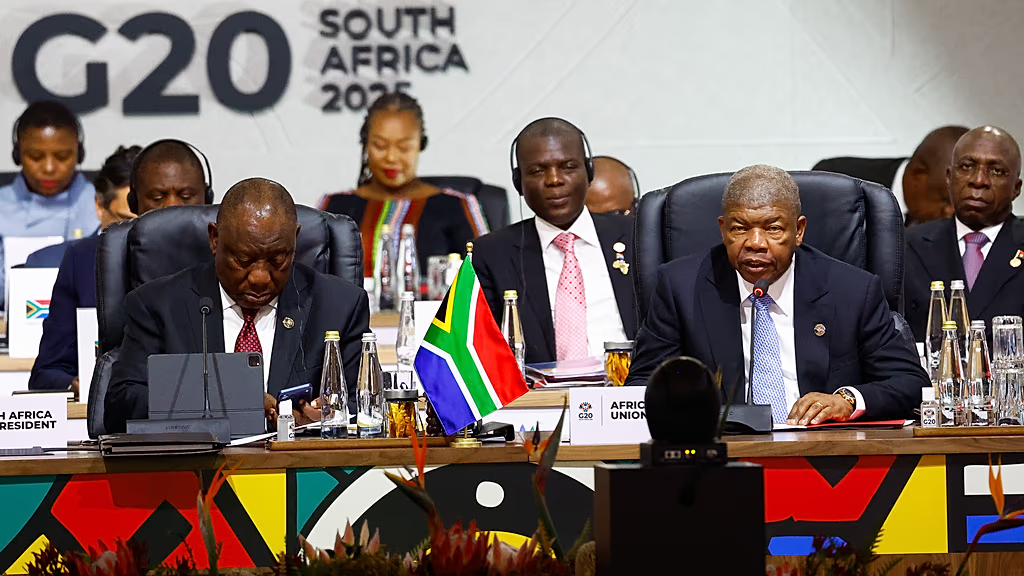
The abrupt deferral creates a temporary vacuum that competing global actors will monitor closely. India’s unique selling proposition to African nations has long been its emphasis on capacity building, institutional autonomy, and democratic transparency—contrasting sharply with heavily securitized or debt-laden alternative models. By championing the African Union’s permanent admission into the G20 during its presidency, New Delhi built immense diplomatic capital on the continent. The postponement stalls the structural operationalization of that goodwill.
The Maritime and Technology Mandate
When the ministerial delegations eventually reconvene, the focus on maritime security in the Indian Ocean will assume even greater urgency. As traditional shipping lanes encounter severe geopolitical disruptions, the security of the maritime corridor linking India’s western coast with East and Southern Africa has become a non-negotiable economic priority. The draft resolutions aimed to establish joint maritime domain awareness networks and shared hydrographic surveys, essentially transforming the Indian Ocean from a zone of foreign naval competition into a secure, African-Indian commercial highway.
Similarly, the delay pushes back critical negotiations regarding technology sharing. African policymakers have grown increasingly wary of importing proprietary, black-box digital solutions that lock national judiciaries and central banks into restrictive licensing agreements. India’s willingness to share its open-source DPI architecture offers African states a route to technological sovereignty, allowing local developers to build customized fintech and e-governance systems tailored to regional realities.
Strategic Implications of the Postponement
While the physical summit in New Delhi is paused, the underlying drivers of the India-Africa axis remain active:
- The Urgency of South-South Health Architecture: The very pathogen that forced the summit’s postponement highlights why healthcare resilience was placed at the center of the IAFS-IV agenda. It underscores that a joint response framework between India’s generic pharmaceutical manufacturing powerhouse and the Africa CDC is an absolute prerequisite for stable trade.
- Supply Chain Interruption Risks: Delaying formal trade corridor agreements prolongs Africa’s reliance on volatile Western and East Asian logistics networks, leaving both Indian manufacturers and African markets exposed to ongoing global inflationary pressures.
- The Imperative of “Humanity First” Diplomacy: New Delhi’s immediate pivot toward offering material and scientific support to combat the Bundibugyo outbreak reinforces its core diplomatic positioning as a compassionate, dependable partner to the Global South during asymmetric crises.
A Solutions-Oriented Outlook for the Interim Period
To ensure that the momentum generated during months of preparatory senior official meetings is not entirely lost, both Indian and African leadership must actively deploy alternative diplomatic mechanisms:
- Transition to Virtual Ministerial Working Groups: The scheduled deliberations on DPI interoperability, rules of origin, and agricultural technology transfers should immediately move to virtual ministerial committees. This will allow technical frameworks to be finalized and ready for immediate execution the moment a physical summit is safely rescheduled.
- Launch an Emergency India-Africa CDC Taskforce: India should immediately leverage its advanced biotechnology and vaccine research institutions to partner with Africa CDC scientists. Jointly funding clinical research into diagnostic tools and potential vaccine candidates for the Bundibugyo strain will demonstrate the “IA SPIRIT” in active, real-time crisis mitigation.
- Fast-track Bilateral Digital Rails: While a continental-wide agreement awaits the plenary, India can proceed with fast-tracking bilateral digital payment links with advanced African economies, utilizing existing frameworks to keep trade conversations moving forward organically.
The Interconnected Frontier
The deferral of IAFS-IV is a stark reminder that in the contemporary global architecture, human security cannot be separated from trade or geopolitics. The very fact that an outbreak in Central Africa can reshape the diplomatic calendar of New Delhi proves that the two regions share a singular, deeply interconnected frontier.
The postponement should not be viewed as a failure of diplomacy, but as a compelling argument for its acceleration. When the fourth iteration of this historic summit is finally convened, it will do so with an undeniable mandate. The leaders of India and Africa will return to the table knowing that building a resilient, self-reliant Global South is no longer a strategic option—it is a matter of absolute biological and economic survival.