ViewPoints Africa Editorial Team
 The quiet town of Ol Kalou has become the epicenter of an aggressive proxy war. On the eve of the final campaign day for one of Kenya’s most consequential parliamentary by-elections, an armed ambush has shattered the peace. This sudden outbreak of violence signals a deep, structural political showdown that could reshape the country’s upcoming general elections.
The Immediate Development in Nyandarua
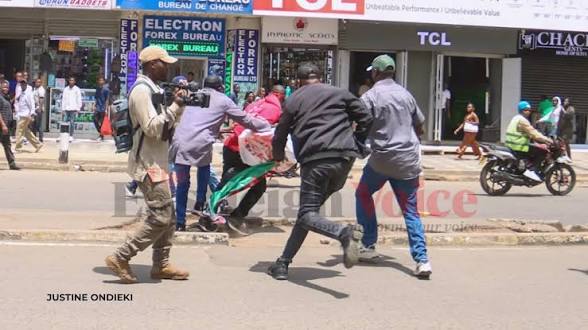
On the night of July 13, 2026, a high-stakes campaign convoy was violently ambushed near Kasuku Centre in Ol Joro Orok, Nyandarua County. Three vehicles with concealed number plates had trailed East African Legislative Assembly Member of Parliament Kanini Kega from Ol Kalou town. Earlier that day, Kega had attended a Democracy for Citizens Party (DCP) rally for candidate Samuel Douglas Kamau Ngotho. When the pursuers closed in, Kega and his driver fled their vehicle on foot, successfully seeking refuge in a nearby homestead.
The armed men then turned their weapons on the empty Toyota Land Cruiser. They smashed its side mirrors, lights, and rear section with rifle butts, while simultaneously opening fire on the vehicle.
In an emotional video recorded from inside a private house in Ol Joro Orok, Kega held up a broken gun butt and a live bullet. He noted that these items had already been handed over to the officer commanding the Kasuku Police Station. Furthermore, he alleged that the attackers were actually state police officers.
This terrifying attack arrived just days before the highly anticipated Ol Kalou by-election. This vote marks the first direct electoral confrontation between President William Ruto’s ruling United Democratic Alliance (UDA) and former Deputy President Rigathi Gachagua’s newly formed DCP.
Alarmingly, it also follows a weekend of violence in nearby Nyahururu. In that incident, Murang’a Governor Irungu Kang’ata alleged his driver was shot during a political rally. This pattern of tightly clustered pre-election incidents has raised deep fears among opposition figures and independent analysts.
The By-Election That Became a National Referendum
To understand the intense temperature around the Kega ambush, one must analyze what this vote means beyond the borders of Nyandarua County. This is not a routine constituency contest. Instead, it serves as a critical political supremacy test between the man who sits in State House and the man he helped to impeach.
Rigathi Gachagua was removed from the office of Deputy President on October 18, 2024. He was the first deputy president in Kenya’s constitutional history to face impeachment. The political machinery behind his removal was widely attributed to President Ruto, with whom Gachagua had been feuding openly.
However, what the political class expected to be his exit from national influence became his springboard instead. Gachagua spent the following months traveling relentlessly through the vote-rich Mt Kenya region. There, he cultivated a powerful narrative of political persecution.
By May 2025, he launched the DCP, a populist vehicle built on the slogan Skiza Wakenya—Listen to Kenyans. By June 2026, the DCP had successfully expanded, attracting prominent defectors from the ruling party. Against this backdrop, the upcoming constituency contest became a true proxy war, pitting Gachagua’s former aide, Sammy Kamau Ngotho, against UDA’s Samuel Muchina Nyagah.
A Police Force Under the Spotlight
The specific allegation Kega made from his hiding place—that the armed men pursuing him were police officers—places the night’s events in a highly alarming category. Kenya has a documented, painful history of state security apparatus being deployed in service of electoral manipulation. Nega’s claims were corroborated at the scene by lawyer Ndegwa Wahome, who alleged that after failing to locate the MP, the officers actively vandalized the abandoned SUV.
Nyandarua County Commissioner Abdirisack Jaldesa confirmed that police have launched an investigation. However, he noted that no official station report had been filed by the victims initially, complicating the opening response.
Kirinyaga Woman Representative Njeri Maina, who rushed to the area, stated that she was also trailed by a suspicious vehicle. She raised a critical institutional conflict of interest regarding the investigation:
- The National Police Service is constitutionally protected to remain neutral.
- However, victims fear the security entities are being abused by the government.
- Consequently, the same institutions asked to investigate are themselves being implicated.
This structural tension suggests either an organized campaign of state-backed intimidation or an extraordinary coincidence. Given Kenya’s recent political history, observers find the former explanation far more credible.
The Mt Kenya Variable and the 2027 Calculus
The extreme intensity unfolding in Nyandarua reflects a deeper political arithmetic that both Ruto and Gachagua understand with precision. Mount Kenya, as an ethnic-political construct, has delivered decisive vote margins in every presidential election since 1991. The region voted overwhelmingly for Ruto in 2022. Therefore, if Gachagua can successfully move a significant portion of that vote into the opposition column, the administration’s 2027 re-election calculus changes fundamentally.
The Ruto government has responded to this regional threat with a combination of structural pressure and direct wealth deployment. Deputy President Kithure Kindiki, who replaced Gachagua, has been systematically deployed to Central Kenya. He brings state resources that opposition legislators describe as electorally targeted.
The upcoming local vote serves as the first real test of whether this strategy of resource distribution can hold back the DCP tide. The fact that Gachagua’s candidate garnered over 12,000 votes in party nominations suggests genuine mobilization at the grassroots level.
Restoring Democratic Norms
If the government’s preferred narrative holds, the Kega attack will be investigated and prosecuted as a standard criminal matter entirely separate from presidential politics. While local police have launched inquiries, the institutional conditions for a trusted process are not self-generating.
Instead, true legitimacy requires that independent civil society organizations and accredited monitors are present in force at polling stations. Results must be transmitted transparently, and any irregularities must be challenged through the courts rather than street violence.
Ultimately, the trajectory of this campaign demonstrates that political contests in Kenya can still be pursued through legitimate party channels. The underlying question the Kega ambush poses is whether the institutions of the Kenyan state will function as they are constitutionally designed to do, or whether they will be subordinated to the interests of raw electoral management. For local voters heading to the polls, that question is no longer abstract.