deshola
 When the Democratic Republic of Congo assumed the chair of the African Union’s Peace and Security Council (PSC) for January 2026, it was easy to dismiss the moment as routine diplomacy a rotational responsibility in a crowded multilateral calendar. That would be a mistake. For a country whose own stability remains fragile and whose regional influence is growing, the chairmanship offers a rare opportunity to shape conversations that directly affect its national interests.
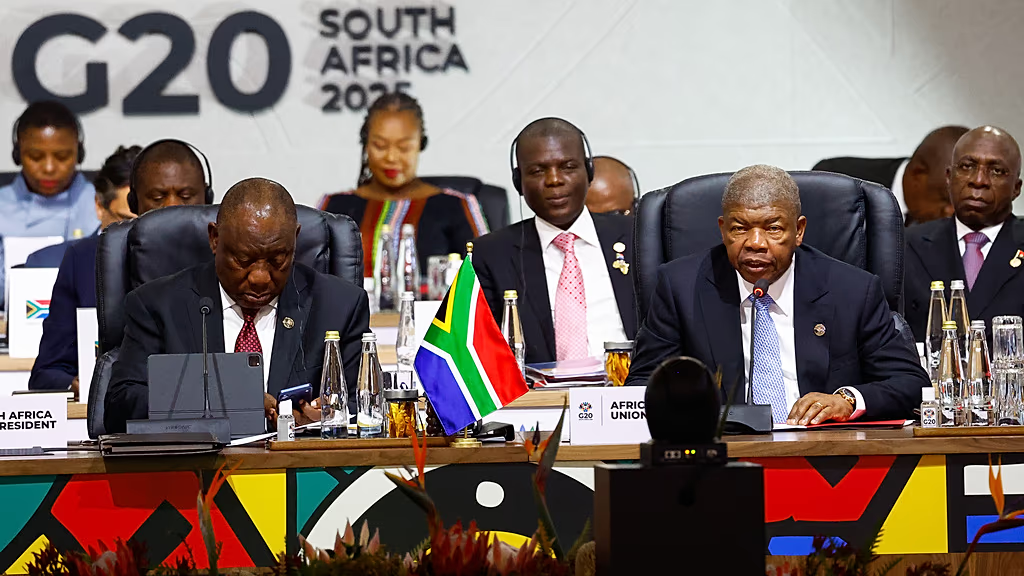
The PSC is not a ceremonial body. It is the African Union’s highest decision-making forum on conflict prevention, crisis management and post-conflict reconstruction. Chairing it places Kinshasa at the centre of Africa’s security architecture, with the power to influence agendas, steer debates and frame priorities. Used well, that platform can translate into tangible diplomatic and strategic gains.
The most immediate benefit lies in agenda-setting. The provisional programme of work for January 2026 includes discussions on elections, sanctions, unconstitutional changes of government and the illegal exploitation of natural resources issues that sit at the heart of Congo’s own security challenges. By foregrounding these themes, the DRC can help push the Council toward addressing root causes of conflict rather than symptoms. In particular, sustained attention to illicit resource flows and arms proliferation offers Congo a continental forum to reinforce a long-standing argument: that insecurity in eastern DRC is not merely local violence, but part of a wider political economy of conflict.
Chairmanship also confers diplomatic visibility at a critical moment. Congo will simultaneously be preparing for its term as a non-permanent member of the United Nations Security Council. The overlap is strategic. Decisions, communiqués and norms emerging from the PSC can be carried into global forums, strengthening Africa-led positions on peacekeeping reform, sanctions regimes and conflict mediation. For Kinshasa, this dual presence amplifies its voice and allows it to position itself not only as a conflict-affected state, but as a contributor to solutions.
There are quieter but equally important gains. Leading the PSC exposes Congolese diplomats and security officials to the inner workings of Africa’s peace machinery early warning systems, mediation tools, sanctions committees and peace support operations. This is institutional learning that can feed back into domestic policy, particularly in areas such as civilian protection, electoral security and coordination with regional forces.
The chairmanship also offers Congo a chance to reshape narratives. For decades, the country has been discussed largely as a site of crisis. Presiding over PSC deliberations allows Kinshasa to project a different image: that of a state capable of leadership, coalition-building and strategic restraint. This matters for investor confidence, regional diplomacy and long-term credibility.
None of this, however, is automatic. The value of the chairmanship will depend on discipline and balance. Congo must resist the temptation to turn the PSC into a platform for narrow national grievances. Effective chairmanship requires impartial facilitation, respect for procedure and sensitivity to the concerns of other member states. Paradoxically, it is precisely by appearing even-handed that Congo can build alliances and goodwill that later translate into support on its own files.
The real test will be outcomes. If January’s deliberations produce clearer continental positions on resource-driven conflicts, stronger coordination on sanctions, or more coherent approaches to elections in fragile states, the chairmanship will have mattered. If it becomes merely another month of statements and closed-door meetings, the opportunity will have passed.
For Congo, the PSC chairmanship is not a solution to its security problems. But it is leverage. It offers a chance to align domestic priorities with continental norms, to move from being the subject of peace discussions to one of their architects. In a region where influence is often reactive, that shift modest as it may seem could prove significant.