oluwatosin oyeniyi
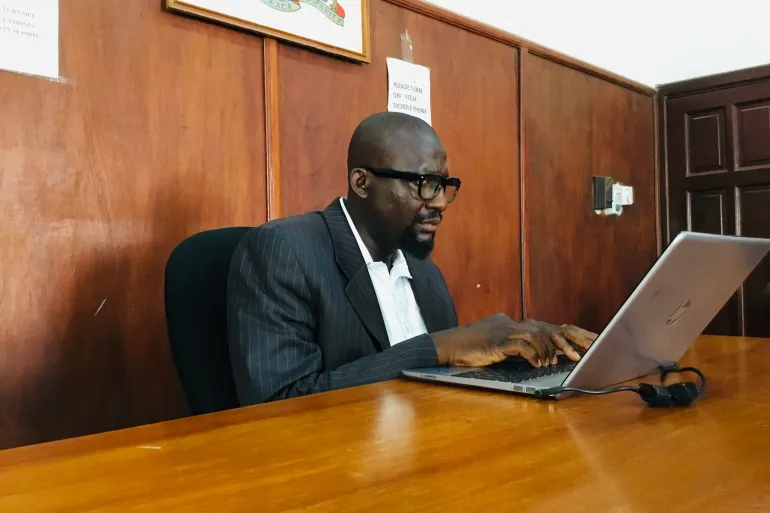
BANJUL, The Gambia — For Magistrate Muhammed Krubally, navigating a courtroom involves more than listening to lawyers, witnesses and defendants. It also means working with technology and support systems in a judicial environment largely designed for people who can see.
Krubally, The Gambia’s first visually impaired magistrate, is drawing attention to the accessibility challenges faced by people with disabilities in professional settings. His experience highlights how assistive technology can support participation while exposing the institutional changes still needed to make the justice system more inclusive.
Appointed to the bench in 2016, Krubally says he has presided over more than 1,000 civil and criminal cases at the Banjul Magistrates’ Court. He uses JAWS (Job Access With Speech), a screen-reading programme that converts on-screen text into speech, to access digital documents and judgments. He also uses artificial intelligence-enabled smart glasses and, when necessary, assistance from his court clerk.
His work challenges assumptions about visual impairment and professional capability. But it also raises a broader question: should people with disabilities have to depend on personal determination and individual workarounds to participate fully in public institutions?
Technology opens doors, but barriers remain
Assistive technology plays an important role in Krubally’s work, helping him access information that might otherwise be difficult to use independently.
Screen readers can make digital documents accessible, while other tools can help users navigate information and carry out tasks. In a courtroom, where legal documents, case files and judgments are central to daily work, reliable access to information is essential.
Yet technology alone cannot guarantee full accessibility. Its effectiveness depends on whether documents are compatible with assistive software, whether the necessary equipment is available and whether institutional procedures accommodate different ways of accessing information.
A court system that relies heavily on inaccessible documents or visual cues can create unnecessary barriers for judicial officers, lawyers, court staff and members of the public with disabilities.
Krubally combines technology with listening skills, memory and professional experience to follow proceedings. His clerk also provides assistance when required. These arrangements help him perform his duties, but they point to the importance of ensuring that accessibility is built into the systems supporting judicial work.
Disability rights and implementation in The Gambia
The Gambia has a legal framework intended to protect the rights of people with disabilities. The Persons with Disabilities Act, passed in 2021, addresses principles including non-discrimination, equality of opportunity, accessibility, participation and access to justice.
However, the existence of legislation does not automatically remove practical barriers.
Disability advocates have raised concerns about difficulties accessing education, employment and public services. Ndey Yassin Secka-Sallah, a visually impaired parliamentarian and disability rights advocate, has described relying on colleagues to follow discussions in the National Assembly, illustrating how entering a public institution does not necessarily mean being able to participate independently.
The challenges begin well before adulthood. The Gambia Organisation of the Visually Impaired operates a resource centre that provides specialist education for children with visual impairments before they transition to mainstream schools. Its head, Lamin Colley, has highlighted shortages of learning materials and the pressure on specialist teachers supporting pupils across school clusters.
These experiences reveal a connected problem: when accessible learning resources and support are limited in childhood, people with disabilities may face additional obstacles pursuing higher education and professional careers.
Improving inclusion therefore requires action across the education system, employment sector and public institutions—not only adjustments at the point where a person enters the workplace.
A judicial system designed for broader access
Krubally’s experience has implications beyond his own career. Courts must be accessible not only to judicial officers but also to people seeking justice, including litigants, witnesses, lawyers and visitors with disabilities.
Practical improvements could include ensuring that electronic case-management systems work with screen readers, providing accessible digital and printed legal materials, training staff in disability inclusion and establishing clear procedures for requesting reasonable accommodations.
Physical access also matters. Court buildings need to accommodate people with mobility impairments, while communication systems should consider the needs of people with hearing, visual and other disabilities.
These changes should be supported by adequate funding, clear institutional responsibilities and regular assessments of whether accessibility measures work in practice. Consulting people with disabilities during the design and review of systems can help identify barriers that might otherwise be overlooked.
The judiciary’s responsibility extends beyond permitting people with disabilities to enter its buildings. It must ensure they can perform their roles, access information and participate in proceedings with dignity and as much independence as possible.
Beyond one person’s achievement
Krubally has also used his experience to encourage younger people with visual impairments to pursue their ambitions. His journey offers an example of what can be achieved when professional opportunity is combined with appropriate tools, support and determination.
However, individual success should not obscure the structural challenges faced by others. A system that depends on exceptional individuals finding ways around inaccessible processes risks leaving many people behind.
The question for The Gambia is whether the experience of its first visually impaired magistrate can help accelerate practical reforms across the justice system and other public institutions.
Accessible technology, inclusive policies, staff training and effective implementation of disability rights can help create environments where people are assessed on their qualifications and work rather than assumptions about their disabilities.
Krubally’s career demonstrates that visual impairment need not prevent someone from serving on the bench. The wider test is whether institutions will make the changes necessary for more people with disabilities to participate independently and equally.
For The Gambia, meaningful inclusion will be measured not only by who succeeds despite existing barriers, but by how far those barriers are removed for everyone who follows.