oluwatosin oyeniyi
MOGADISHU, Somalia — Somalia’s Council of Ministers has approved proposed amendments to the country’s national electoral and political parties laws, advancing reforms aimed at restructuring the electoral system and expanding direct voting across national and regional political institutions.
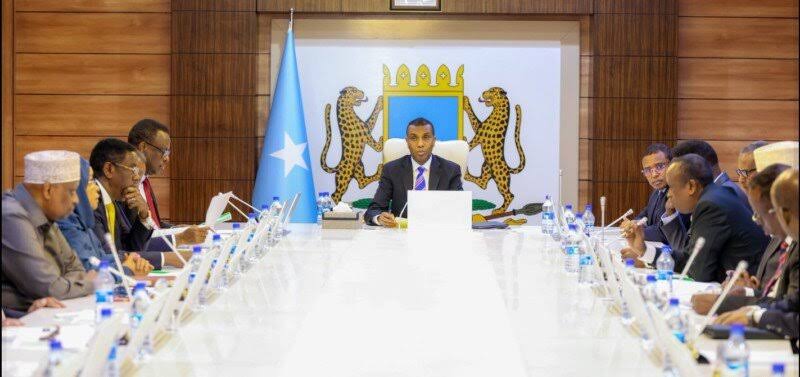
The amendments were approved during an extraordinary Cabinet meeting chaired by Prime Minister Hamza Abdi Barre on November 24. The proposals affect 23 articles of the National Electoral Law and eight articles of the country’s political parties law, introducing closed-list elections and a 10 per cent threshold for political parties seeking national recognition.
The draft legislation will now proceed to Parliament for consideration, where lawmakers are expected to debate the proposed changes and their implications for Somalia’s evolving political and electoral framework.
What the proposed electoral reforms introduce
The proposed amendments seek to establish a framework for direct elections in which citizens vote for political parties or candidate lists rather than relying on the indirect electoral arrangements that have historically characterised Somalia’s federal elections.
Under the proposed system, voters would elect members of local councils, state assemblies and both chambers of the Federal Parliament. The elected institutions would subsequently select their respective executive leaders, including the country’s president.
The amendments also introduce closed-list elections, under which political parties determine the order of candidates on their electoral lists before voting. Seats won by a party would be allocated to candidates according to the ranking established by the party, rather than voters selecting individual candidates within the list.
This differs from an open-list system, in which voters can influence which candidates from a party are elected by expressing preferences for individual names.
The proposed change could increase the influence of political parties over candidate selection and the distribution of legislative seats, while reducing voters’ ability to determine the specific individuals elected from a party’s list.
The Cabinet also approved a proposed 10 per cent threshold for political associations seeking recognition as national political parties. Under the proposed arrangement, political associations that secure at least 10 per cent of the vote in federal elections would qualify for national party status.
The reforms are intended to establish clearer electoral rules, strengthen the role of political parties and align electoral legislation with Somalia’s constitutional framework.
Somalia’s transition towards direct elections
Somalia has spent years attempting to transition from its indirect electoral system towards a model of direct elections.
For much of the country’s recent political history, parliamentary representatives have been selected through clan-based electoral arrangements involving delegates and electoral colleges rather than universal suffrage.
The system, commonly associated with the 4.5 power-sharing formula, allocates political representation among Somalia’s major clan groupings and minority communities. Although it has been used as a mechanism for managing political representation, it has also faced criticism for limiting democratic participation and reinforcing clan-based political structures.
In the 2022 federal elections, parliamentary representatives were selected through indirect processes, after which lawmakers elected President Hassan Sheikh Mohamud.
Somalia’s electoral reforms have sought to move beyond this system towards broader participation in elections. In March 2024, Parliament approved constitutional amendments introducing direct universal suffrage, a multiparty system and changes to presidential and parliamentary terms, among other provisions.
The amendments to the electoral and political parties laws approved by the Cabinet are part of the broader legislative process aimed at implementing the country’s evolving constitutional and electoral framework.
However, the transition has remained politically contentious, with disagreements over the electoral timetable, constitutional changes, the distribution of authority between federal and regional governments and the rules governing elections.
Political disagreements complicate electoral reforms
The proposed amendments come amid disagreements between Somalia’s federal government, opposition groups and some regional administrations over the country’s electoral arrangements.
Opposition figures and regional leaders, including those associated with Puntland and Jubaland, have raised concerns about the government’s approach to electoral reforms, arguing that changes to the electoral framework should be negotiated through broader political consensus.
The Somali Future Council, an opposition coalition that includes leaders from Puntland and Jubaland, has opposed aspects of the government’s electoral approach and advocated alternative arrangements, including proposals for direct voting for certain parliamentary seats.
The disagreements extend beyond electoral technicalities to questions of federalism, political representation, constitutional interpretation and the balance of power between Mogadishu and Somalia’s federal member states.
Puntland and Jubaland have been particularly vocal in disputes over the federal government’s constitutional and electoral decisions, reflecting longstanding tensions over the extent of central government authority.
The opposition has also called for mediation and broader political negotiations to resolve disagreements surrounding the electoral process.
These divisions could complicate the implementation of the proposed electoral amendments, particularly if regional administrations and opposition stakeholders remain unwilling to participate in arrangements they consider insufficiently inclusive.
What closed-list voting could mean for political representation
The proposed introduction of closed-list voting represents a significant change in how electoral competition could operate in Somalia.
Under a closed-list system, political parties become central to the selection of elected representatives. Parties determine candidate rankings before elections, and voters cast ballots for the party rather than choosing individual candidates from its list.
The arrangement could encourage the development of organised political parties, simplify ballot structures and strengthen party-based electoral competition.
However, it could also raise concerns about internal party democracy, candidate accountability and the influence of party leadership over the selection of representatives.
The proposed 10 per cent threshold could further shape the political landscape by limiting national party recognition to political associations that secure a minimum level of electoral support.
While thresholds are commonly used in electoral systems to prevent excessive fragmentation, their effects depend on how they are designed and implemented. In Somalia, the threshold could influence the ability of smaller political associations and emerging parties to gain national recognition.
The eventual impact of the reforms will therefore depend on the electoral regulations, political party structures, implementation arrangements and safeguards adopted by lawmakers.
Parliament to consider proposed amendments
Following Cabinet approval, the proposed amendments will be submitted to Parliament for consideration.
Lawmakers will have to examine the changes, determine whether they are consistent with the constitutional framework and decide whether the proposed electoral arrangements should be adopted.
The legislative process is likely to attract political scrutiny, given the disagreements surrounding electoral reforms and the country’s broader constitutional transition.
The government faces the challenge of implementing a new electoral framework while securing sufficient political agreement among federal institutions, opposition groups and regional administrations.
For Somalia, the proposed amendments represent another step in efforts to establish a more direct electoral system and expand political participation.
However, the success of the reforms will depend not only on legislative approval but also on political consensus, institutional independence, public confidence and the willingness of competing political actors to participate in the electoral process.
As the proposals move to Parliament, Somalia’s electoral transition remains a defining political issue, with the outcome likely to shape the country’s democratic institutions and federal political arrangements.